
Round 6, were friends/foes now foes/friends by Stephanie Concepcion Ramirez
March 3 – April 21
“You can judge the moral fiber of a political regime…. by the degree of danger they consent to.” – Roque Dalton (Salvadoran Poet)
Stephanie Concepcion Ramirez b. 1984 is a Salvadoran-American artist from Prince George’s County, Maryland. She received her BFA at Old Dominion University in Norfolk, VA and her MFA at the University of Texas at Austin. Her work is based on notions of memory, personal and historical amnesia that trace the veins of the Central American diaspora. In an attempt to reconcile with her personal and cultural histories and memories, she combines images, installations and text that validate truth, false memories, filtered history and fantasy. Ramirez is privileged and grateful to currently work and live in the original land of the Akokisa people.


Round 7, Color Composition by Aryel René Jackson
April 27 -June 3
Aryel (Ar-y/ee-el) René Jackson (they/them) (b. 1991, Louisiana) Jackson currently works in Austin, Texas, and teaches foundation courses at Texas State University in San Marcos. They are an alum of The University of Texas at Austin (2019), the Skowhegan School of Painting and Sculpture (2019), the Royal College of Art Exchange Program (2018), and The Cooper Union (2013). Their films have screened at the Museum of Modern Art, New York (2022); the Baltimore Museum of Art (2021); and The Momentary in collaboration with the Crystal Bridges Museum (2020). Jackson’s work has been exhibited at galleries and institutions such as Artpace, San Antonio (2022); Women & Their Work, Austin (2022); IDEA Lab, Art Gallery at Black Studies at The University of Texas at Austin (2021); Dallas Contemporary (2021); Jacob Lawrence Gallery, Seattle (2021); SculptureCenter, New York (2019); New Museum, New York (2019); Contemporary Art Center, New Orleans (2018); and the Studio Museum in Harlem (2016). In 2021, Jackson was awarded the Tito’s Art Prize.
Round 7: Color Composition recalls nearly a century of history. In 1928 the Koch and Fowler City Plan proposed the creation of a “Negro District” in Austin, TX which segregated Black Americans to areas with the weakest zoning restrictions allowing a series of systematic development abuses. In 1935 the New Deal program further reinforced segregationist boundaries through restrictions on mortgages for Black and Latinx homeowners. Working in tandem with the government, the Home Owners Loan Corporation created a map of “Hazardous” and “Desirable” areas. In Color Composition, Jackson considers this history of redlining in Austin through a system of colored balloons that match the general layout of HOLC-designated areas from 1935. Throughout the duration of the installation, weather and natural effects will reveal the balloons’ true color, thus initiating dialogue between the past and the present.
For more information about the history of redlining in Austin visit: http://projects.statesman.com/news/racial-geography/

Round 8, This is Everything by Tammie Rubin
July 27 – September 9
Tammie Rubin (b. Chicago, Il) is an artist whose sculptural practice considers the intrinsic power of objects as signifiers, wishful contraptions, and mythic relics while investigating the tension between the readymade and the handcrafted. Using intricate motifs, Rubin delves into themes involving ritual, domestic and liturgical objects, mapping, migration, magical thinking, longing, and identity. Her installations open up dream-like spaces of unexpected associations and dislocations. Rubin received a BFA in both Ceramics and Art History from the University of Illinois, Urbana-Champaign, and an MFA in Ceramics at the University of Washington in Seattle.
What is the artist’s studio? It has many names and varying definitions, but at its core, it is simply a place in which an artist works. How an artist works within that space, however, is multifaceted; studios become venues for contemplation, experimentation, collaboration, labor, critique, and all the like. Often mysterious to the public eye (and public imagination), the studio can be a place of refuge or a trap, a sacred space or a torment, depending on the on the artist’s progress.
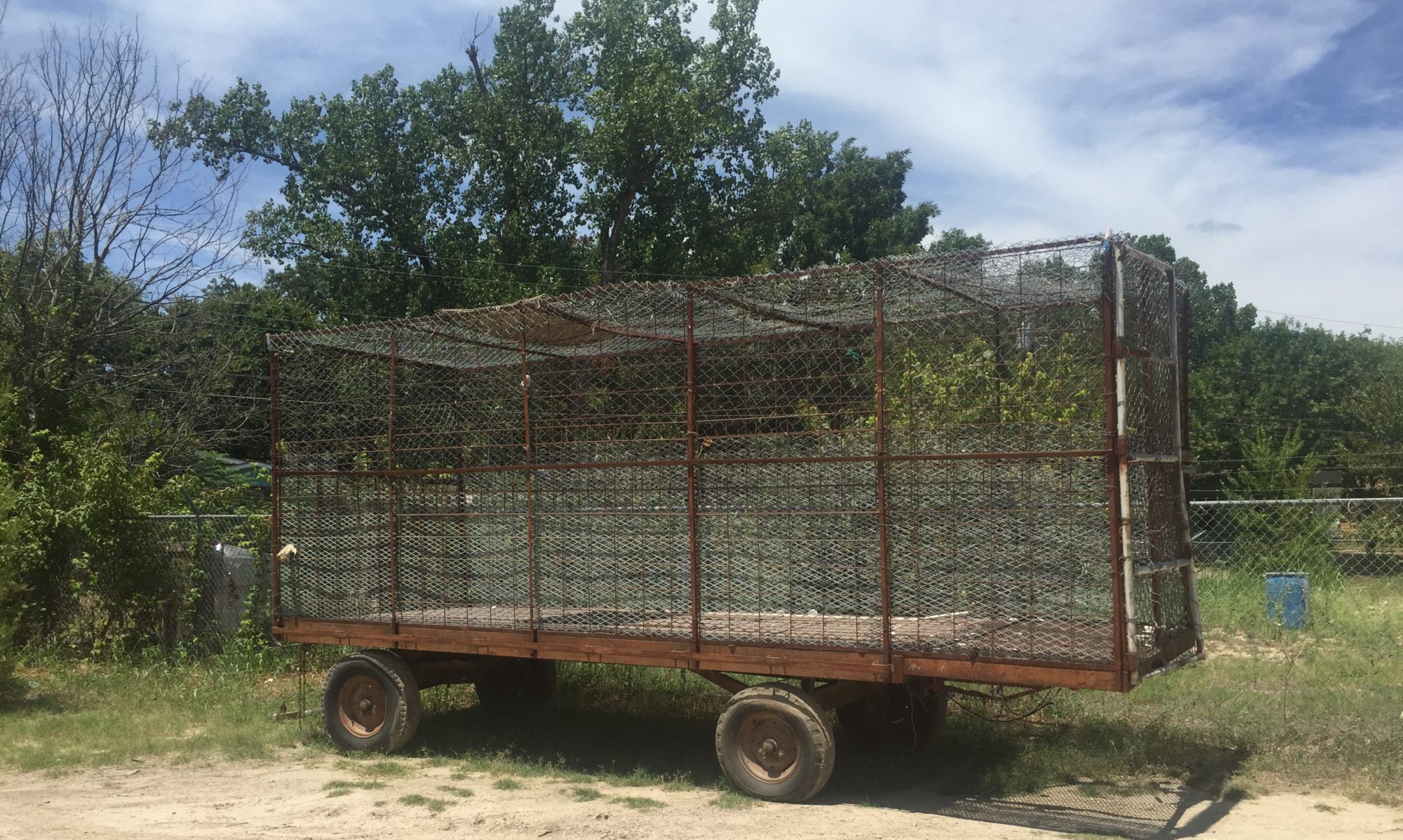
In Cage Match Project Round Vlll: This is Everything, Tammie Rubin makes the studio visible––and her practice publicly accessible––within the confines of the caged trailer.
During the timeline of her exhibition, Rubin will have scheduled hours in which she will work within the cage. The act of making will vary from the very active to the most mundane of tasks. Tight and unorthodox, the cage- turned- studio is meant to challenge traditional and often romanticized perceptions of artists’ working space, as well as the realities of displacement, which forces artists into conditions that are less than ideal.
“I am usually solitary in the studio, so working in such a visible way, along with the environmental challenges of working outdoors in the Texas summer, will add a level of physical and mental endurance to my practice, as well as elements of performance. The cage will become my laboratory, a place of process and experimentation. The work I will make will not be completed there, but are sculptural components for an exhibition at Women and Their Work in November.” -Tammie Rubin


Round 9, I see london, I see france by Annie Miller
November 10 – March 9
Annie Miller‘s work explores a space of sensuality and desire; the longing to touch, to penetrate, to hold and make contact and the inherent failure or displacement of this longing. Miller holds an MFA in Painting from The University of Texas at Austin and a BFA in Painting and Drawing from California State University Fullerton. She has exhibited throughout the country and currently lives and works in Austin, Texas where she is a lecturer in Studio Art at The University of Texas at Austin and Texas State University.
“Simone meanwhile amused herself by slipping the eye into the profound crevice of her ass, and after lying on her back and raising her legs and bottom, she tried to keep the eye there simply by squeezing her buttocks together. But all at once, it spat out like a stone squeezed from a cherry.”
-Georges Bataille, Story of the Eye
On the surface, Georges Bataille’s Story of the Eye reads like a (sometimes incoherent) surrealist, pornographic fantasy. As I read this text, I am equal parts intrigued, excited, and embarrassed. I eventually slow down and look deeper. It then becomes clear to me that Bataille’s use of sensory language enables an encounter with the impossible, where boundaries of “the real” and fantasy momentarily converge.
Similarly, my paintings merge everyday domestic routine with a waking aspirational fantasy life. I explore ideas, desires, influences, and personas without a hierarchy: my shadow merging with the shadow of my dog, a fight I had with my partner, a game I made up as a little girl, the desire to sit on a fan on a hot day. Boundaries of “the real” and imagined fluidly shift, reflect, and coalesce into paintings and then are reflected back into life experiences.
ROUND NINE: I see london, I see france, uses the cage as a space for perceiving–a space where fantasy, reality, desire, touch, play, penetration, terror, voyeurism, exhibitionism, shame, and pleasure are visualized before ultimately falling apart. ROUND NINE: I see london, I see france is a space where the viewer, like Simone in Story of the Eye, can embrace the eye and that fleeting moment where sensuality, desire, “the real”, and fantasy meet–before inevitably slipping away once more.


